
Your Next Sale Is Already in Your Customer List. Here's How to Find It.
The most expensive habit in most SME marketing isn’t the ad spend. It’s the customer list nobody ever contacts again.
I’ve looked at a fair number of Malaysian SME CRMs over the last few years. The picture is almost always the same: an active top of funnel — some ads, some leads, maybe a WhatsApp bot capturing enquiries — and then a complete black hole after the sale closes. The customer pays. The invoice gets sent. The WhatsApp thread goes quiet.
And the founder goes back to the top of funnel to find the next new person.
Where the Revenue Is Actually Sitting
The math on existing customers isn’t complicated. A customer who has already bought from you has already done the hardest thing — they’ve trusted you once. Getting them to buy again, or refer someone else, or upgrade their arrangement, requires a fraction of the effort of acquiring someone cold.
Most of the founders I’ve sat with in KL and PJ tell me referrals already make up 30–40% of their revenue. Sometimes more. But those referrals arrive randomly — a contact mentions a name, a happy customer forwards a WhatsApp thread. There’s no system behind it.
The referrals are already coming. The question is whether you’re building a system that makes them happen reliably, or waiting for luck.
The Three Plays That Work
The E in X-RACE is the (E)ngage stage — post-purchase follow-up, reactivation, referral triggers, upsell sequences. For most Malaysian SMEs, this stage is completely blank. Nothing happens after the sale.
Three specific approaches that convert:
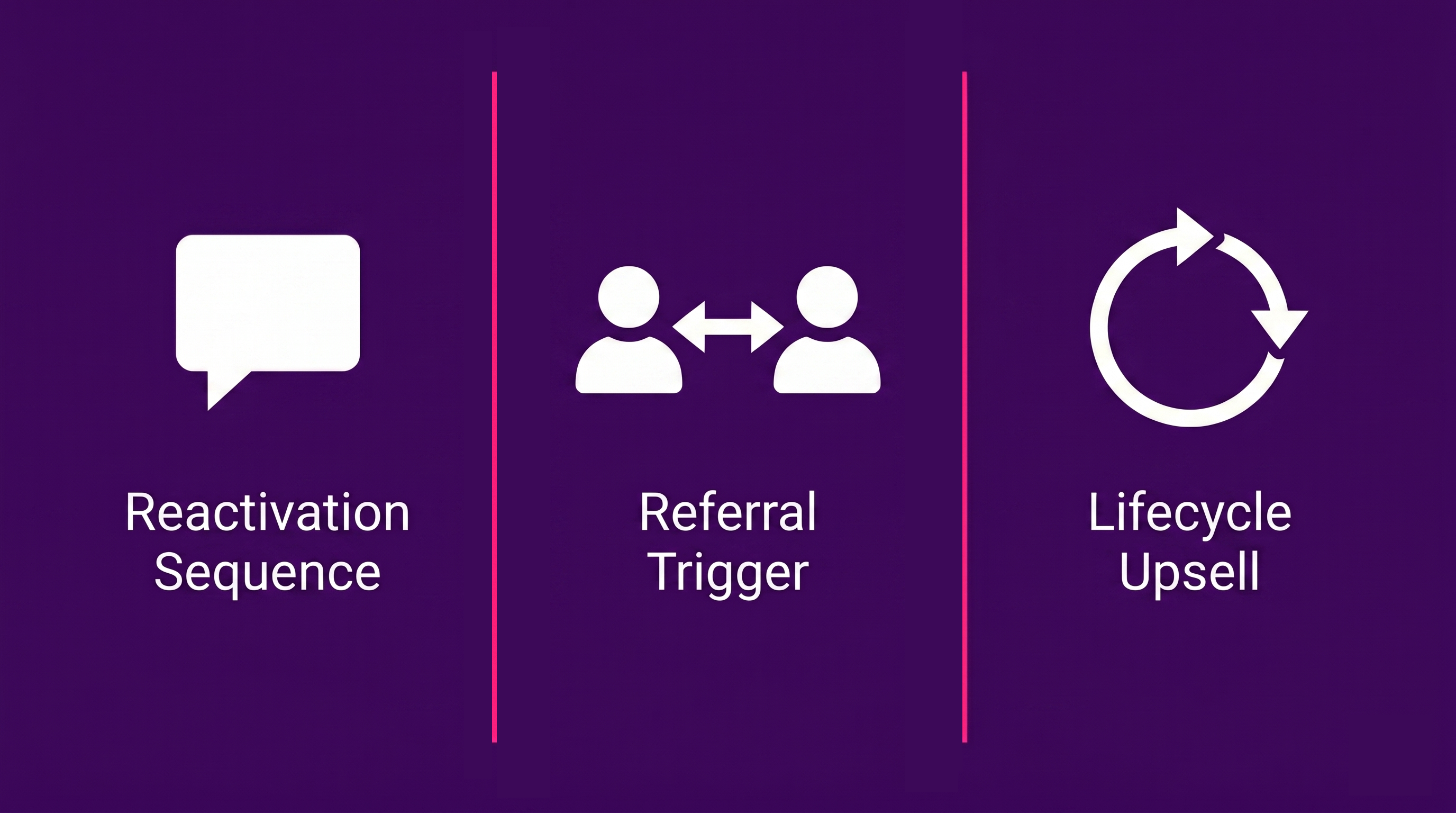
Reactivation — the 2-message sequence. Pull any customer who’s been quiet for 60 days or more. Send a WhatsApp from the founder — not a broadcast template, a personalised first-name message that references their last purchase or project. Message 1 is a check-in: how did that go, is everything running well. Message 2 follows two days later with a specific offer relevant to where they are now.
An HVAC company in Petaling Jaya ran this across 40 dormant customers in February 2025. Thirteen replied. Six turned into new jobs. Revenue from that 2-message campaign: RM34,000. Time to execute: about three hours, including writing both messages.
Referral trigger — the 7-day ask. Most referrals happen when the customer is at peak satisfaction — within the first week or two after a purchase or project completion. Build a WhatsApp message that fires at the 7-day mark. Don’t ask generically (“do you know anyone who might need our services?”). Give them a specific frame: “If you have a friend in manufacturing who’s dealing with the same problem you had — I’d be glad to help them the same way. Happy to make time for them this month.”
Specificity makes referrals happen. Vague asks get forgotten.
Upsell or renewal — based on lifecycle. If your product or service has a natural renewal point — annual contract, maintenance cycle, seasonal need — build a sequence that reaches out at the 80% mark, not at expiry. By expiry, the customer has often started looking around. The 80% outreach, via WhatsApp, personal, from the founder or account manager, keeps the relationship warm and gives you first right to renew.
For a cybersecurity reseller in Shah Alam, setting up this 80% renewal reminder across 120 accounts added RM180,000 in renewal revenue in 2024 — revenue that would otherwise have required reselling from scratch, against competitors who’d had months to get in.
Why This Doesn’t Get Done
The honest reason is that running an (E)ngage-stage program feels less urgent than chasing new leads. When the pipeline feels thin, the instinct is to spend on ads, turn on the top of funnel, and find new people.
That instinct is understandable and usually wrong.
Adding volume to the top of a leaky funnel means more revenue escaping through the same holes. The E-stage is how you close the holes — turn one-time buyers into repeat buyers, turn satisfied customers into referral sources, turn expiring contracts into renewals before competitors get access.
If your business has been running for more than two years with 50 or more past customers, there is almost certainly more revenue sitting in that list than in your current ad campaign.
Fix the leak before scaling the tap.
The Sequence to Build
You don’t need a CRM with complex automation to start this. Three WhatsApp message templates and a list sorted by last purchase date is enough to begin.
Week 1: Identify dormant customers — anyone who hasn’t been contacted in 60 days or more. Send the 2-message reactivation sequence.
Week 2: Build the 7-day referral trigger. Pick your five most recent completed sales. Send the ask personally.
Week 3: Map your renewal points. What percentage of your revenue renews annually or seasonally? Build the 80% outreach message for the next wave of renewals.
None of this requires new tools. It requires knowing where your existing customer base is, and having a reason to contact them that isn’t “we’re following up on your quote.”
The Next Step
Pull your customer list from the last 12 months. Identify who hasn’t been contacted in 90 days or more.
That’s where to start.
If you want a structured way to audit your full revenue funnel — including where the Engage-stage is missing and what to build first — the SME Funnel Fixer covers this in about fifteen minutes.
[Get the SME Funnel Fixer (For Free) →]
Or if you'd rather work through it with someone, Whatsapp us here.
[WhatsApp Us]
-Brian Wong