
"Predictable Revenue" Was Misunderstood for a Decade
“Predictable Revenue” Was Misunderstood for a Decade
I’ve been watching the phrase “predictable revenue” move through Malaysian SME strategy decks for a few years now. It started showing up in agency proposals around 2022 — usually on a slide with an upward-trending graph and a promise about CRM automation. The founders sitting across from me had heard the phrase enough times that it stopped sounding like a claim and started sounding like a fact. Buy the system. Hit the number. Done.
Almost none of them could tell me what it actually required.
Where the Phrase Came From
“Predictable Revenue” is the title of a 2011 book by Aaron Ross, who was an outbound sales rep at Salesforce. The book is about how to build a team of cold-calling SDRs, separate the prospecting function from the closing function, and run a structured pipeline at scale. It’s a good book. It was written for a technology company with hundreds of employees, a defined product, and the budget to run structured experiments over 18-month cycles.
It was not written for a 12-person services business in Petaling Jaya where the founder does the pitch and the delivery and the WhatsApp follow-up and the invoicing.
The phrase escaped the book. It got picked up by SaaS growth blogs, retooled for agency sales packages, and landed in Malaysian SME marketing proposals as a promise with the mechanism stripped out. What arrived was the goal, without the instructions.
Three Things Founders Got Wrong
When I ask founders what “predictable revenue” means to them, I usually get one of three answers.
A sales forecast. Revenue they expect at the start of the month, based on what’s in the pipeline. This is useful — but a forecast is not a system. It tells you what you think will happen. It does nothing to ensure it does.
A CRM with pipeline stages. A board with columns: Enquiry, Qualified, Proposal, Closed. The assumption is that moving deals across a board is the same as managing a sales process. It isn’t. A CRM is a database. Moving things between columns is record keeping, not architecture.
Retainer income. Monthly recurring revenue from a handful of long-term clients. This feels the most like predictable revenue — it’s consistent, at least. But consistency and predictability are different things. Consistent income tells you what happened last month. Predictable revenue tells you what will happen next month. Those are opposite directions.
None of these are wrong to want. All three break the same way: when one piece drops — a referral source dries up, a retainer client churns, a founder gets sick — the whole thing unravels. Because it was never connected.
What Predictable Revenue Actually Requires
Three systems, connected. Not any single one of them in isolation.
Predictable lead flow. You know, within a reasonable margin, how many qualified enquiries will arrive this month — and that number doesn’t depend on whether the founder is at full capacity or chasing referrals from last year’s clients. The system brings leads in whether or not you’re feeding it manually.
Predictable conversion. You know your close rate on qualified leads, because your follow-up is documented, timed, and not living in the founder’s head. Someone on the team — or an automated sequence — can handle the first three touches without a briefing every time.
Predictable retention. You know how long clients stay, what they buy next, and what triggers the conversation — because there’s a post-purchase process that runs whether or not the account manager remembered to call.
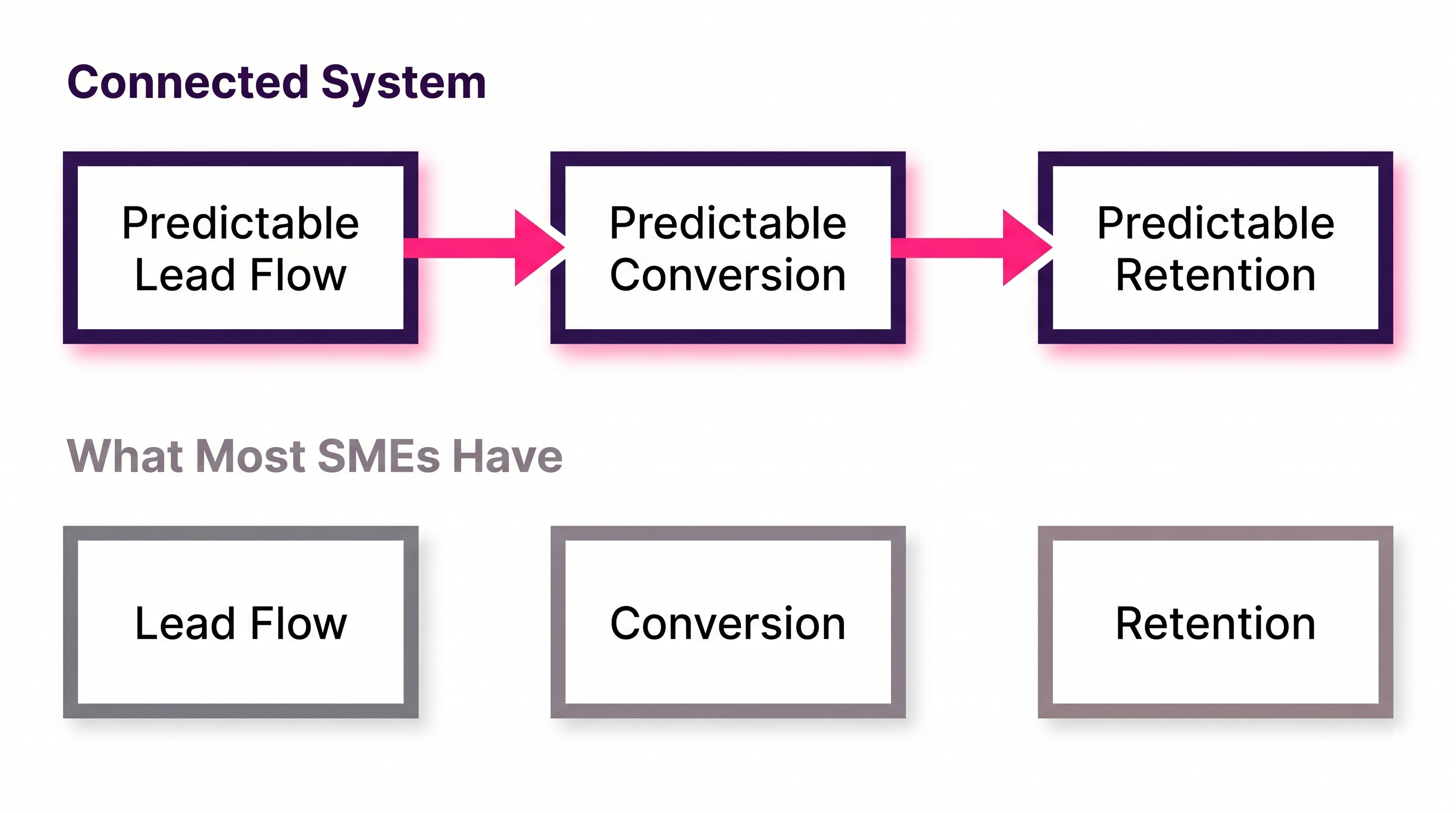
The failure point for most SMEs I sit with in KL and PJ isn’t that they have none of these. It’s that they have fragments. A Meta ad campaign that brings leads when the founder is managing it. A close rate that works because the founder closes everything personally. A handful of loyal clients who stay because of the relationship, not the system.
Fragments aren’t a system. Fragments give you the good month / dead month pattern: a strong quarter, then a slow one, then a scramble to figure out what changed. Nothing changed — the effort that produced the good quarter was yours, and you ran out of it.
What It Looks Like When It’s Built
For a 10-person business in Malaysia, a connected revenue system doesn’t require a RM10,000-a-month technology stack. The architecture matters more than the tool.
What needs to be in place: an acquisition system that brings qualified leads consistently without the founder being online at 11pm (Reach and Act stages of X-RACE). A follow-up system that handles the first five touchpoints automatically — WhatsApp, email, or both — so the founder only steps in when a lead is warm (Convert). A post-purchase sequence that keeps clients engaged, generates referrals, and surfaces upsell moments without a manual reminder (Engage).
MomentumOS handles most of this for a fraction of what most founders are already spending across three disconnected vendors. The bottleneck is almost never the tool. It’s that no one designed the architecture.
The Actual Question to Ask
If your revenue is unpredictable right now, the question isn’t “what should I spend on marketing.” It’s “which of the three systems is missing, and which is disconnected from the others.”
Nine times out of ten, at least two of the three are broken or absent. The SME Funnel Fixer maps that gap — which stages are working, which are leaking, and what to fix first. It takes about fifteen minutes. Most founders find the break point in the first ten questions.
[Get the SME Funnel Fixer (For Free) →]
Or if you'd rather work through it with someone, Whatsapp us here.
[WhatsApp Us]
-Brian Wong